A podcast script is not a performance in disguise. At its best, it is a practical plan that lets a host sound present, ask better questions, and keep an episode useful from the first sentence to the last. The listener should hear a natural conversation or a confident explanation, not the paper in front of the microphone.
This template is designed for hosts, producers, and teams who want enough preparation to make each episode clear without squeezing the life out of it. Use the complete version for a solo episode. For an interview, use the opening, topic beats, questions, and close, then let the guest’s answers determine the path between them.
Start with the job of this episode
Before you write an introduction or research a guest, name the one thing this episode should give the listener. A good answer is specific. “Talk about leadership” is a subject area. “Show a first-time manager how to handle an early mistake without losing trust” is an episode job.
That distinction protects the recording from drifting. It helps you decide which stories belong, what to leave out, and what a listener should still remember an hour later. It also makes the episode easier to title and describe once the edit is finished.
Write this at the top of your page: After this episode, the listener should understand, feel, or be able to do ______. Keep that sentence visible while you prepare. If a question, example, or tangent does not serve it, save it for another episode.
A simple podcast script template
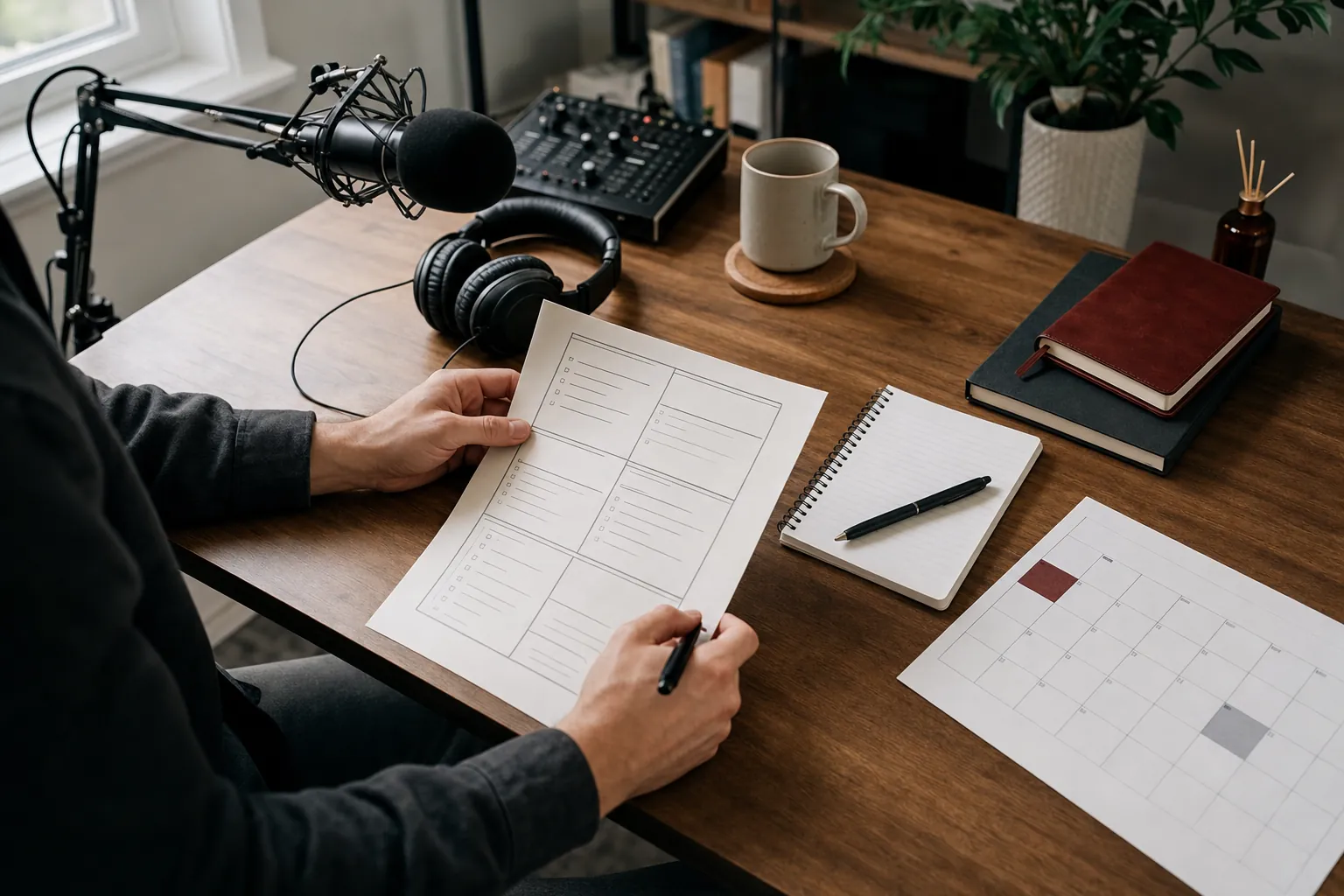
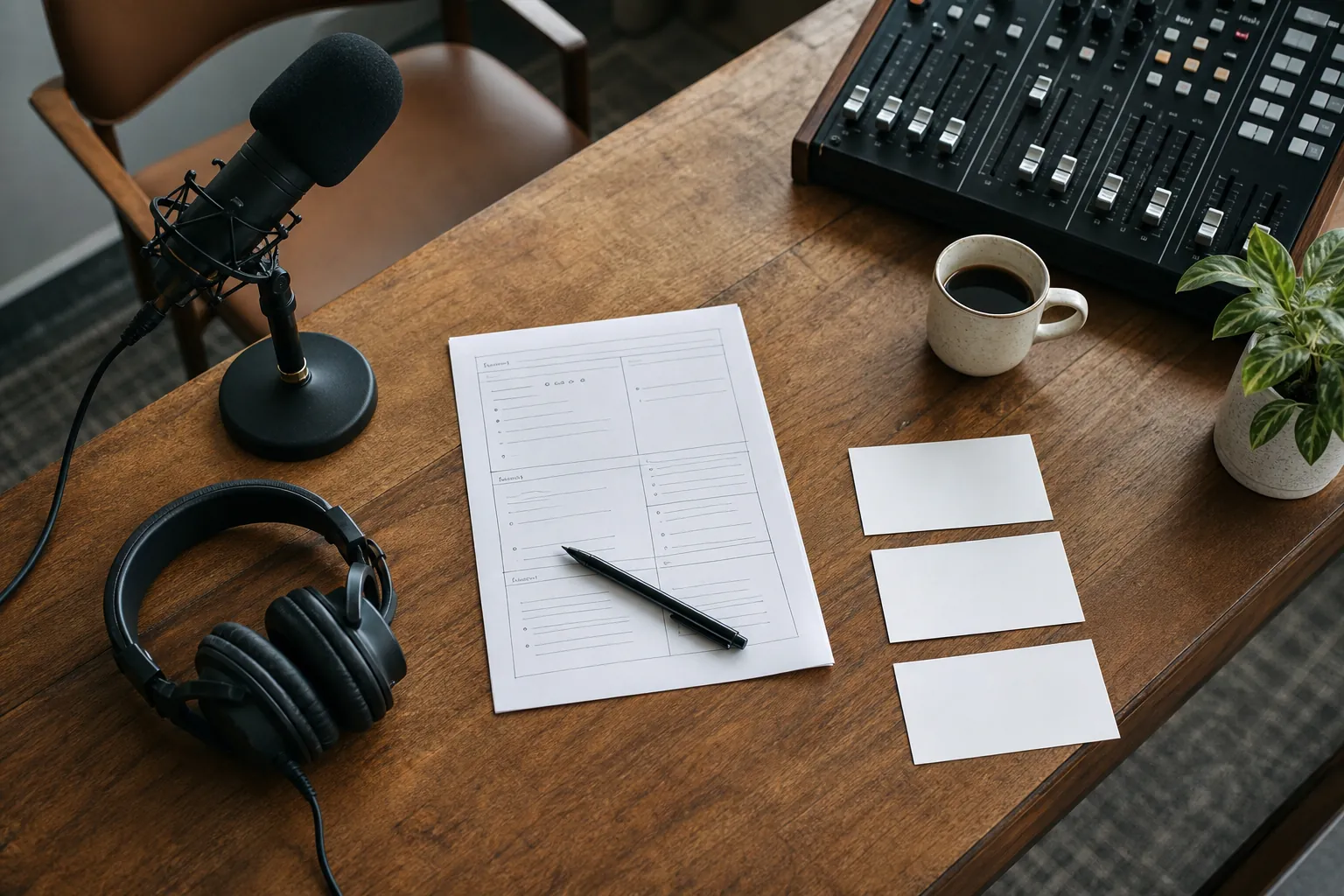
Use these headings as a working outline. You do not need to fill every line with full sentences. The point is to prepare the thinking that allows the recording to feel easy.
- Episode title or working topic: Name the question, tension, or outcome, not just the broad category.
- Listener promise: One sentence on what the right listener will get from this episode.
- Opening: A short welcome, the topic, and why it matters now.
- Context: The essential background a listener needs before the main conversation begins.
- Main beats: Three to five ideas, stories, or questions in a useful order.
- Transitions: A few notes on how one section naturally leads to the next.
- Close: The takeaway, any honest next step, and a clear sign-off.
- Production notes: Names, pronunciation, links, clips, approvals, or follow-up work for the edit.
For a short solo show, those sections may become a near-complete script. For an interview, they become a brief that helps the host listen with purpose. Either way, the outline is there to serve the listener’s experience, not to prove how much preparation happened.
Write an opening that gets to the point
Many podcast openings try to do too much. They introduce the show, welcome the listener, explain the host’s background, mention every platform, thank several people, and only then arrive at the subject. That can be appropriate for a special episode, but it is not a good default.
A stronger opening answers three questions quickly: who is this for, what are we talking about today, and why is it worth staying? Here is a flexible structure:
“You’re listening to [show name], where [listener benefit]. Today, [guest or topic] is here to help us understand [specific question]. By the end, you’ll have a clearer sense of [useful outcome].”
Adapt that to your voice. It does not need to be spoken word for word. The value is in the order: welcome the listener, identify the subject, and make a modest, honest promise. If your show already has a familiar opening, add only what this particular episode needs.
The premise should be settled before you try to script around it. Mark’s guide to choosing a podcast format can help clarify what repeats from episode to episode, while the guide to podcast descriptions helps turn the broader show promise into plain language.

Plan the middle in beats, not blocks of prose
The middle of an episode needs shape, especially when a guest has a lot to say. But a host who reads a long sequence of formal questions can make an intelligent guest sound as though they are taking an exam. Use beats instead: a short series of places the conversation needs to visit.
For example, an interview about changing careers might move through the first sign a change was needed, the decision point, the difficult practical step, what surprised the guest, and the advice they would give someone beginning now. That sequence gives the host a route without dictating the actual conversation.
Under each beat, prepare one main question and one possible follow-up. Main questions should invite a story, example, or decision. Useful prompts include: “What did that look like in practice?”, “Can you take us to the moment you realized that?”, “What did you try first?”, and “What would someone miss if they only saw the finished result?”
Follow-ups are not a failure to prepare. They are where the best material often appears. If a guest gives a phrase that a listener may not understand, ask them to unpack it. If they describe an important choice, ask what they weighed. If they mention a setback, ask what changed afterward. The outline gives you the confidence to slow down when the conversation becomes more useful than the next planned question.
Use questions that produce a real answer
Questions shape the answer you receive. A broad prompt such as “Tell us about your work” can be a reasonable opening, but it often invites a rehearsed summary. A more specific question gives the guest something concrete to respond to and gives the listener a better way into the subject.
Compare “What are the challenges of your job?” with “What is the decision you now make differently because you have seen this problem up close?” The second question asks for perspective, not a list. It is more likely to produce the kind of detail that stays with a listener.
Prepare questions in three levels: the big question that carries the episode, the supporting questions that explain how or why, and the follow-ups that reveal the human or practical detail. Mark’s guide to podcast interview questions has more ways to shape those prompts before recording day.

Write transitions only where they help the listener
Transitions are small pieces of editorial work. They remind the listener why the conversation is moving and make a change of subject feel intentional rather than abrupt. You do not need one after every answer. Use them when you are leaving a complex point, introducing a new section, or connecting a guest’s experience to the listener’s question.
A good transition is usually one or two sentences. It might summarize a useful thought, name the next tension, or ask the guest to take the conversation somewhere specific. “You’ve explained why the first year was difficult. I want to turn to what changed when you had enough evidence to make a different decision.” That is enough. The host does not need to narrate every turn in the road.
For a solo episode, transitions matter even more because the listener has only one voice to follow. Place a brief signpost before a new idea, particularly after a story or a dense explanation. Then let the substance do the work.
Prepare a close that gives the episode a landing
Do not let a good conversation end with “Well, I think that’s all the time we have.” The close is the final chance to help the listener keep what was useful. It can be brief, but it should feel earned.
Start by returning to the episode job you wrote at the beginning. What is the one idea, choice, or practice that deserves to leave with the listener? Say it in your own words. Then offer one appropriate next step. That might be another episode, a resource mentioned in the conversation, or an invitation to follow the show. Keep it relevant. A close does not need to become a list of every place the audience can find you online.
For an interview, a final question can create a clean ending: “What would you want someone beginning this work to remember?” or “What is the question you wish more people asked before making this decision?” Listen for an answer with a real conclusion, then thank the guest and let the episode end without rushing into another topic.
Build a recording script that serves the edit
A useful outline helps the person editing the episode as well as the host. Put names, titles, correct spellings, pronunciation notes, links, and any required approvals in one place. Flag where a clip, music cue, or sponsor note belongs. If a guest mentions a report, book, or organization you will include in the show notes, mark it while you can still verify the details.
During the recording, make a simple time-stamped note when something needs attention. It may be a strong quote, a technical interruption, a point to fact-check, or a section the host wants to revisit. This does not replace an editor’s listening. It simply saves the team from having to reconstruct every decision from memory later.
Guest preparation makes this much easier. A clear podcast guest briefing gives someone the context, technical guidance, and expectations they need to arrive ready for a better conversation.

How much should you script?
There is no virtue in scripting less than the episode needs. A tightly timed narrative, a sensitive organizational message, or a ten-minute teaching episode may need carefully written language. In those cases, write it for the ear. Use short sentences, read it out loud, and remove anything you would not naturally say.
Interviews, roundtables, and conversational shows usually need less wording and more thinking. Script the welcome, key facts, complex names, transitions that must be precise, and the close. Outline the rest. The real test is whether the host can hear the answer and respond to it. If they are always scanning the next paragraph, the listener can hear that too.
Give yourself permission to edit the template after a few recordings. You may discover that a certain opening gets to the point faster, that guests respond better to fewer questions, or that the close needs a clearer prompt. A good script is not a fixed document. It is a production tool that gets better as the show finds its rhythm.
Make preparation part of a stronger production process
The script is only one part of a dependable episode. The same preparation should connect the listener promise, guest briefing, recording setup, edit, title, description, and release plan. When each piece supports the same purpose, the show feels more assured without becoming over-produced.
Mark helps hosts and organizations make that process practical, from shaping a pilot and preparing interviews to editing the finished episode and building a release rhythm that can last. Explore podcast launch services or ongoing podcast production support, or book a free consultation to talk through the work behind the show.
Frequently asked questions
Do podcasts need a script?
Most podcasts benefit from a prepared outline, even when the conversation itself is spontaneous. A full word-for-word script can be useful for a short solo episode, an introduction, or a sensitive passage. For interviews and discussions, clear beats and questions usually create a more natural result.
How long should a podcast script be?
Use only as much detail as the format needs. A ten-minute solo briefing may need a full page or more. An interview may need one page with the opening, the guest context, the main questions, a few follow-ups, and the close. The outline should keep the episode moving, not give the host something to read aloud.
What should a podcast introduction say?
A useful opening names the listener, the subject of the episode, and the reason it is worth their time. Keep it short enough to reach the conversation quickly. If the guest or topic needs context, give the one or two details that make the rest of the episode easier to follow.
How do I keep an interview from sounding scripted?
Prepare the structure, then listen to the answer. Write questions that invite stories and examples rather than speeches. Leave room to follow a useful detail, and treat your outline as a map rather than a checklist you must finish.
Photos: Jakub Zerdzicki via Pexels, George Milton via Pexels, SERHAT TURAN via Pexels, and Jeremy Enns via Pexels.